
A century of change in alpine flora
A century after the surveys of botanist Denis Coquoz, seven high-altitude sites in the Vallée du Trient Regional Nature Park were revisited to measure how their flora has changed.
Repeating historical plant surveys on the summits of the Trient to measure the effects of climate and environmental change on high-altitude flora.
In the early 20th century, Denis Coquoz, a farmer from Les Marécottes and a renowned amateur botanist, recorded the flora of the Trient region. A century later, the Vallée du Trient Regional Nature Park wanted to repeat these surveys to understand the effects of climate and environmental change on its territory, in particular on the flora of the summits.
Our role
bmgr environmental consulting was commissioned by the Park for part of these surveys: locating the historical sites, repeating the inventories in the field, then analysing and documenting how the flora has changed.
Finding sites described a century ago
Each plot was relocated using the descriptions and altitudes recorded by Coquoz and coordinates suggested by the Park, then refined in the field by searching for the dominant species. Seven sites were revisited in summer 2026: three on the Bel Oiseau, two on the Luisin, one at Fontanabran and one at La Chaux-Derrière, up to almost 2,800 m.
Comparing two periods
At each site, the entire vascular flora was recorded, with particular attention to the species cited by Coquoz. The species lists were then compared between the two periods, and changes in ecological conditions were assessed using Landolt indicator values (moisture, light, soil reaction, temperature, nutrients, continentality).
A project at the interface of field botany, historical data and biodiversity monitoring.
Deliverables
- Summary report with one sheet per site: location, comparison with the historical survey, photographs and vegetation table
- Georeferenced surveys, submitted to the national InfoFlora database
- Charts of changes in species and indicator values, per site and for the whole area
Do you have a similar project?
Tell us about your context: we reply within two working days.
Other projects
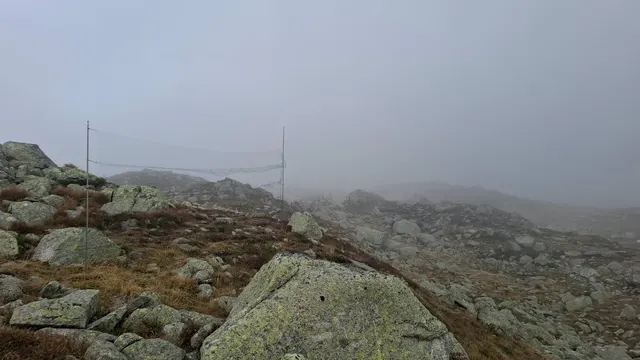
At the heart of alpine migration 2026
Monitoring of migrating birds and raptors at the Pfitscher Joch in Tyrol, combining observation, scientific marking and monitoring.
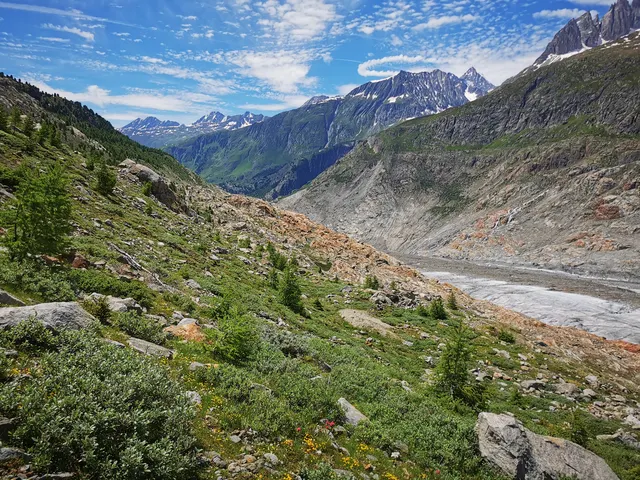
Eight decades of vegetation at the edge of the Aletsch Glacier 2026
Archives since 1943, surveys repeated in 2024 and aerial photographs analysed with deep learning: reconstructing vegetation change at the edge of the largest glacier in the Alps.
Training observers, understanding birds 2026
Theoretical training in handling wild birds, focusing on ethics, law, safety and good practice.